MA 201 CMR 17
Massachusetts 201 CMR 17 Compliance — Protecting Personal Information of MA Residents
Triton Technologies helps businesses comply with Massachusetts 201 CMR 17 — Written Information Security Program development, access controls, encryption, endpoint security, and third-party vendor management for businesses that hold personal information of Massachusetts residents across CT, NY, RI & MA.
MA 201 CMR 17 Requires a Written Information Security Program for Any Business with MA Resident Data
Massachusetts 201 CMR 17.00 — Standards for the Protection of Personal Information of Residents of the Commonwealth — is one of the most comprehensive state data security regulations in the United States. The regulation applies to any person that owns or licenses personal information about Massachusetts residents, including businesses located outside Massachusetts. There is no revenue threshold, employee count minimum, or industry limitation — any business that holds personal information about Massachusetts residents, in any form, must comply. The Massachusetts Attorney General enforces the regulation and has authority to seek civil penalties and injunctive relief.
Triton Technologies provides complete 201 CMR 17 compliance services for businesses across:
- Connecticut
- New York
- Rhode Island
- Massachusetts
The regulation requires a comprehensive Written Information Security Program (WISP) documenting all administrative, technical, and physical safeguards for personal information; specific mandated technical controls including access management, password policies, encryption, and malware protection; and contractual requirements for third-party service providers. The WISP is the foundational compliance document — it is the first item investigators and auditors request, and its quality signals the overall maturity of your data security program.
Written Information Security Program
Massachusetts 201 CMR 17 requires every covered business to maintain a comprehensive Written Information Security Program (WISP). The WISP must be an actual written document — not a verbal policy or informal practice — that is appropriate to the size, scope, and type of business, the amount of resources available, the amount of data stored, and the need for security and confidentiality. Triton develops WISPs that are genuinely tailored to your organization rather than generic templates — the specific controls documented must match the actual controls implemented, or the WISP creates liability rather than protection.
The required WISP elements include: the scope of the program and the personal information it covers; administrative safeguards including employee training and disciplinary measures; technical safeguards including access controls, encryption, and malware protection; physical safeguards protecting paper and electronic records; third-party service provider requirements; a process for evaluating the program’s continued effectiveness; and procedures for responding to security breaches. Each element must be documented in sufficient detail that a regulator examining the WISP can verify the controls exist and are operational.
Employee training and disciplinary measures are required WISP components that are frequently overlooked. The WISP must include a training program for employees who handle personal information, and it must include disciplinary measures for WISP violations. Triton develops training curricula covering the specific types of personal information your organization holds and the security controls employees must follow, delivers training through your preferred platform, maintains attendance records, and documents the disciplinary framework — all in a format that satisfies the 201 CMR 17 training and disciplinary measure requirements.


Access Controls & Authentication
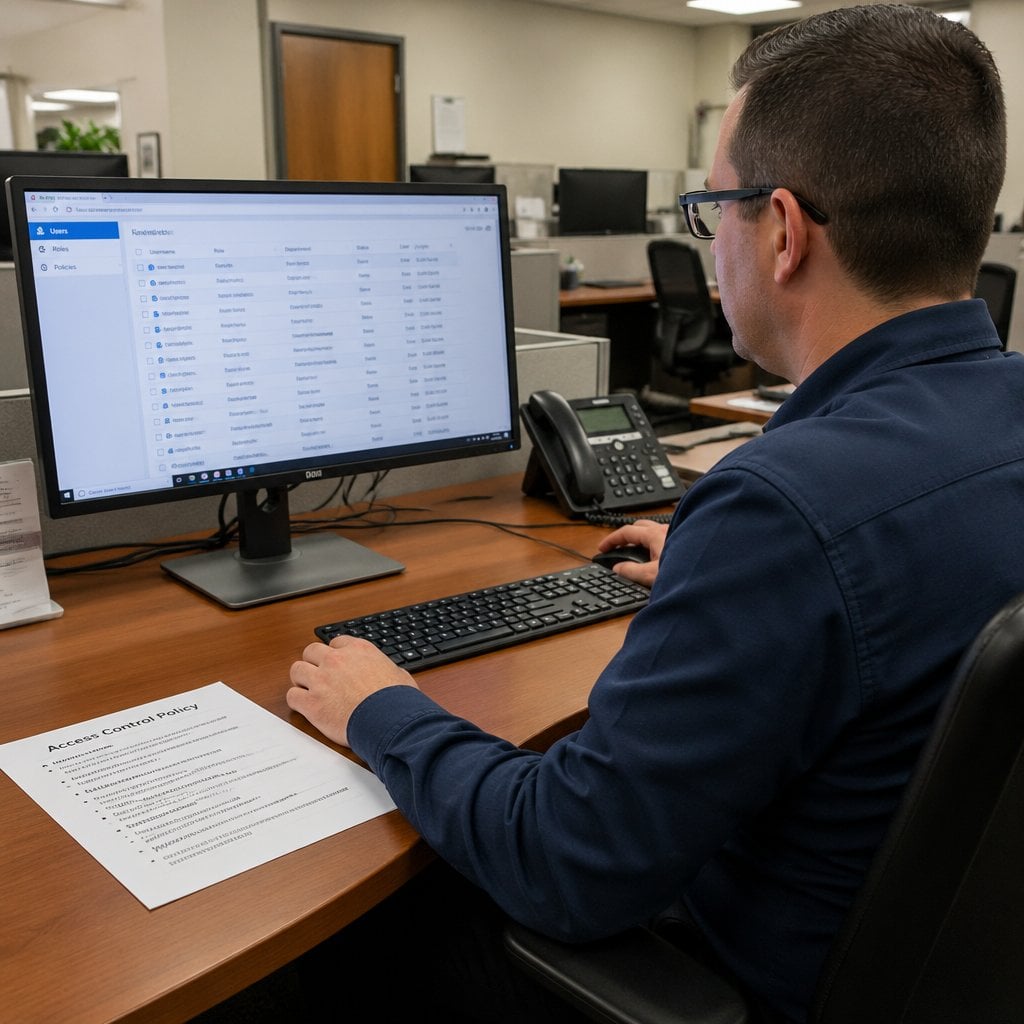
Massachusetts 201 CMR 17 mandates specific technical controls for access management. The regulation requires secure user authentication practices, including: control of user IDs and other identifiers; a reasonably secure method of assigning and selecting passwords; control of data security passwords to ensure such passwords are kept in a location and/or format that does not compromise the security of the data; and restricting access to active users and active user accounts only. Triton implements these controls through a combination of identity management policies, password policy enforcement via Active Directory or equivalent directory services, and multi-factor authentication for remote access to systems containing personal information.
Access restriction to those with legitimate business need is a cornerstone of the 201 CMR 17 access control requirements. The regulation requires that access to personal information be restricted to those employees who need such information to perform their job duties. This principle of least privilege must be implemented technically — through role-based access controls — and documented in your WISP. Triton implements role-based access control frameworks that enforce need-to-know access, conducts quarterly access reviews to identify and remove unnecessary permissions, and maintains the access management documentation required by the regulation.
Procedures for blocking access upon employee termination or role change are specifically required by 201 CMR 17. Terminated or transferred employees who retain access to systems containing personal information represent one of the most common sources of data security incidents. Triton implements automated account termination workflows integrated with your HR system, emergency access revocation procedures for involuntary terminations, and documented review processes for role changes — ensuring access rights are always calibrated to current job responsibilities and revoked immediately upon separation.
Encryption & Technical Safeguards
Massachusetts 201 CMR 17 contains specific, mandatory encryption requirements. The regulation requires encryption of personal information stored on laptops or other portable devices and encryption of personal information transmitted wirelessly or across public networks. Unlike some regulations where encryption is an “addressable” or risk-based consideration, the MA 201 CMR 17 encryption mandate is explicit — businesses that allow personal information to reside on laptops, USB drives, mobile devices, or be transmitted over the internet without encryption are in direct violation of the regulation, regardless of whether a breach occurs. Triton implements full disk encryption on all portable devices and TLS/SSL encryption for all personal information transmitted over networks.
Up-to-date firewall protection and malware protection for systems that store or process personal information are mandatory technical controls under 201 CMR 17. The regulation requires reasonable monitoring of systems for unauthorized use of or access to personal information, up-to-date software security patches, and education of employees about the importance of personal information security measures. Triton deploys and manages next-generation endpoint protection, network firewall infrastructure, patch management programs, and centralized security monitoring — all of which are directly responsive to 201 CMR 17 technical safeguard requirements.
Secure disposal of records containing personal information is required by the Massachusetts data disposal law (M.G.L. c. 93I), which sits alongside 201 CMR 17: paper must be redacted, burned, pulverized or shredded, and electronic media destroyed or erased so the information cannot practicably be read or reconstructed. Triton implements a records retention and disposal program that maps each category of personal information to a documented retention period, automates deletion workflows where possible, and uses NIST SP 800-88-compliant media sanitization procedures for physical media disposal. Disposal certificates are maintained for all media sanitization events.

Third-Party Vendor Management
Massachusetts 201 CMR 17 requires that businesses contractually obligate their third-party service providers to implement and maintain appropriate security measures for personal information. Specifically, the regulation requires that contracts with third-party service providers that have access to personal information of Massachusetts residents include provisions requiring the service provider to implement and maintain appropriate security measures. This requirement applies to any vendor that touches personal information — cloud providers, IT managed service providers, payroll processors, marketing platforms, and any other service provider with access to your customer or employee data.
Third-party risk management under 201 CMR 17 requires more than a contract clause. Businesses must conduct appropriate due diligence on service providers before sharing personal information, verify that service providers maintain security practices consistent with their contractual commitments, and monitor ongoing compliance. Triton conducts initial vendor security assessments using standardized questionnaires aligned with 201 CMR 17 requirements, reviews responses, and provides findings that support both contract negotiations and documentation of your vendor oversight program.
Contract remediation is frequently the highest-volume task in a 201 CMR 17 compliance implementation. Many businesses have dozens or hundreds of vendor relationships involving personal information, and most legacy contracts predate the regulation or were negotiated without awareness of the data security requirement. Triton reviews your vendor contract inventory, identifies relationships involving Massachusetts resident personal information, assesses whether existing contracts contain compliant security provisions, and provides data security addenda and amendment language for vendor contracts that fall short of the 201 CMR 17 standard. We prioritize remediation by data volume and sensitivity, ensuring the highest-risk vendor relationships are addressed first.
MA 201 CMR 17 Applies to ANY Business That Has Massachusetts Resident Personal Information — Even If Located Outside MA
There is no industry limitation, revenue threshold, or geographic exemption for 201 CMR 17. Any business that holds personal information about Massachusetts residents — regardless of where it is located — must maintain a documented WISP and implement all required technical controls. Triton builds complete, AG-defensible 201 CMR 17 compliance programs. Contact us to start with a gap assessment.
MA 201 CMR 17 — Frequently Asked Questions
Who must comply with MA 201 CMR 17?
Massachusetts 201 CMR 17 applies to any person that owns or licenses personal information about residents of the Commonwealth of Massachusetts. There is no minimum employee count, no revenue threshold, and no industry restriction. The regulation applies to businesses located outside Massachusetts just as it applies to Massachusetts-based businesses — the trigger is holding personal information about Massachusetts residents, not being located in Massachusetts. The regulation has no HIPAA exemption, so healthcare organizations must meet both. Commonwealth agencies and political subdivisions fall outside its definition of “person”, but virtually all private businesses that hold personal information about Massachusetts residents — including customer data, employee data, and patient data — are subject to the regulation.
What personal information does MA 201 CMR 17 protect?
Under 201 CMR 17, personal information means a Massachusetts resident’s first name and last name or first initial and last name in combination with any one or more of the following: Social Security number; driver’s license number or state-issued identification card number; or financial account number, or credit or debit card number (with or without any required security code). Personal information does not include information that is lawfully obtained from publicly available information or from federal, state, or local government records lawfully made available to the general public. The regulation covers personal information in both electronic and paper form.
What must a Massachusetts WISP include?
A 201 CMR 17-compliant WISP must document the scope of the program, the personal information it protects, and the administrative safeguards (including employee training and disciplinary measures), technical safeguards (access controls, encryption, malware protection, monitoring, patch management), and physical safeguards (physical access controls, paper record handling) in place. The WISP must also document third-party service provider requirements, a process for evaluating the program’s continued effectiveness, and breach response procedures. The WISP must be written, maintained, and updated as business circumstances change. Regulators reviewing the WISP expect to see specific, operational controls described — not vague aspirational language.
What technical controls does 201 CMR 17 require?
Massachusetts 201 CMR 17 mandates the following technical controls: secure user authentication practices including password management; restriction of access to personal information to those with a legitimate business need; encryption of personal information stored on laptops and portable devices; encryption of personal information transmitted wirelessly or over public networks; reasonable monitoring for unauthorized access; up-to-date firewall protection for systems containing personal information; up-to-date software security patches; up-to-date malware protection; and education of employees about security. These controls are required “at a minimum, and to the extent technically feasible”; where encryption of laptop-stored personal information is feasible, a business cannot choose to skip it.
How does encryption factor into MA 201 CMR 17 compliance?
Encryption is one of the most explicit and unambiguous requirements of 201 CMR 17. The regulation specifically requires encryption of personal information stored on laptops or other portable devices and encryption of personal information transmitted wirelessly or across public networks. Unlike HIPAA, where encryption is an addressable safeguard subject to risk analysis, the Massachusetts requirement applies to the extent technically feasible, and for laptops and internet transmission it almost always is. A business that allows employee laptops to contain personal information without full disk encryption, or that transmits personal information over the internet without TLS encryption, is in direct violation of 201 CMR 17 — and a breach involving such data would trigger both notification obligations and regulatory scrutiny of the encryption failure.
What are the penalties for 201 CMR 17 violations?
The Massachusetts Attorney General enforces 201 CMR 17 under the Massachusetts Consumer Protection Act (Chapter 93A). Violations may result in civil penalties of up to $5,000 per violation under Chapter 93A, with each affected consumer potentially constituting a separate violation. Willful or knowing violations may result in double or triple damages. The AG may also seek injunctive relief requiring implementation of compliant security measures. Following a data breach, investigations typically examine whether the breached business maintained a compliant WISP, whether encryption was in place for the affected data, whether employee training had been conducted, and whether third-party vendors had appropriate security obligations in their contracts. Gaps in any of these areas become leverage for enforcement.
How does Triton help with MA 201 CMR 17 compliance?
Triton Technologies provides end-to-end MA 201 CMR 17 compliance services for businesses across Connecticut, New York, Rhode Island, and Massachusetts. We begin with a gap assessment to identify all personal information of Massachusetts residents in your environment and measure your current security program against 201 CMR 17 requirements. We then build the complete compliance program: a custom Written Information Security Program, role-specific employee training with documentation, access control implementation (role-based access, password policies, MFA for remote access), laptop and portable device encryption, network security and patch management, third-party vendor contract review and remediation, and a breach response plan. Ongoing compliance management keeps your program current as your business and the regulatory environment evolve.
MA 201 CMR 17 Requirements
Triton implements all Massachusetts 201 CMR 17 data security requirements for businesses that hold personal information of MA residents.
Written WISP
Custom Written Information Security Program documenting all administrative, technical, and physical safeguards.
Employee Training
Role-specific data security training with documented attendance — a required WISP element under 201 CMR 17.
Access Controls
Role-based access restrictions, need-to-know enforcement, and termination workflows for personal information systems.
Authentication
Password policies, unique user IDs, and multi-factor authentication for remote access to personal information.
Encryption
Full disk encryption on laptops and portable devices; TLS for all personal information transmitted over networks.
Endpoint Security
Up-to-date malware protection, firewall management, security patching, and endpoint monitoring.
Vendor Contracts
Third-party service provider contract review and data security addenda for all vendors with access to personal information.
Program Updates
Periodic WISP review and update as business changes, new threats emerge, and MA AG guidance evolves.
How Triton Delivers
The Sophos XDR Mandate
We deploy Sophos Firewalls as the non-negotiable perimeter standard. Any firm operating without synchronized endpoint protection is an insurance liability. Sophos Endpoint (EDR/XDR) is the mandatory internal security layer.
AWS Scalability
We deploy on AWS because downtime is not an option. When a critical system goes down, AWS support responds with enterprise urgency, not a ticket queue. Every dollar of downtime is a dollar your IT provider owes you an answer for.
The AI Autonomous Advantage
Axiom, Triton’s proprietary AI monitoring system, gives our engineers real-time visibility that off-the-shelf tools cannot replicate. It is not for sale, it is how we deliver.
Founded in 2001
25 Years of IT Expertise
Serving New England
5 Regional Offices + Dublin & BVI
Under 10 Minute Response
84th Percentile · MSPbots Verified
Sophos Silver · Microsoft Solutions Partner
Security & Cloud Partners
HIPAA · CMMC · SOC 2 · PCI
Multi-Framework Compliance
Let's Discuss Your IT Needs
Triton Technologies delivers managed IT services, cybersecurity, and IT support for businesses across New England. Contact our team today to start a conversation about your technology environment.