Vendor Management
Vendor Management Services
Triton Technologies manages your technology vendor relationships — contracts, SLAs, renewals, performance reviews, and risk assessments — so you never overpay or get locked into the wrong vendor.
Vendor Sprawl Is Costing You Money and Security
The average mid-sized business has 40 to 80 technology vendors — software subscriptions, hardware suppliers, cloud services, and managed service providers — most of which are managed through a combination of email inboxes, spreadsheets, and individual department credit cards. This vendor sprawl creates redundant tools, missed renewals, auto-escalating contracts, and security risks from unreviewed third-party access to your systems and data.
Triton Technologies provides managed vendor management services that give you complete visibility and control over your technology vendor ecosystem. We audit, consolidate, and actively manage your vendor relationships — ensuring you have the right vendors, at the right price, with the right contractual protections and security standards in place.
The Result Speaks for Itself
3
Hours
Others Failed for Weeks
Hundreds
Online
Employees Restored
6+
Systems
Integrated in One Session
Large Enterprise — Rhode Island (Multi-Vendor Crisis)
A large Rhode Island corporation received a CIDR block from their ISP and spent weeks unable to configure their SonicWall firewall to integrate all vendor services simultaneously — HVAC, access controls, and internet. They could reach the internet but nothing beyond basic connectivity worked. Multiple vendors pointed fingers at each other. Hundreds of employees were unable to fully function on the network.
Triton required total control and full disclosure. We assembled every vendor in a single room, accessed the firewall and ISP simultaneously, gathered the complete picture no single vendor had ever had, and programmed the SonicWall correctly. In three hours, every system was operational: HVAC, access controls, and all additional IP services. Hundreds of employees were back on the network the same session with exactly the security configuration the client had requested.
What Changed
Full control first
Triton required total control and full disclosure before starting.
One room
Every vendor assembled together while the firewall and ISP were accessed at the same time.
The whole picture
The complete configuration view no single vendor had ever had.
Three hours
What had failed for weeks was resolved in three hours.
Every system back
HVAC, access controls and all additional IP services operational.
Security as requested
Hundreds of employees back online in the same session, configured exactly as the client asked.
What failed for weeks. Resolved in three hours. All vendors. One room. One solution.
Vendor Inventory & Contract Management
A complete vendor audit is the foundation of effective vendor management. Triton catalogs every technology vendor in your organization — software, hardware, cloud services, and managed services — including:
- contract terms
- renewal dates
- spend
- data access levels
Most organizations discover 20% to 30% more vendors than they thought they had during this initial audit.
Triton maintains a centralized contract repository with all vendor agreements, amendments, and addenda — organized, searchable, and accessible when you need them. Every contract is abstracted into a summary of key terms: auto-renewal provisions, price escalation clauses, termination rights, data portability, and SLA commitments.
Renewal tracking ensures that no vendor contract auto-renews without a conscious decision to continue the relationship. Triton provides advance notice for every upcoming renewal — typically 90 to 180 days out — with a recommendation on whether to renew, renegotiate, or replace the vendor based on performance and current market alternatives.

SLA Management & Performance Reviews
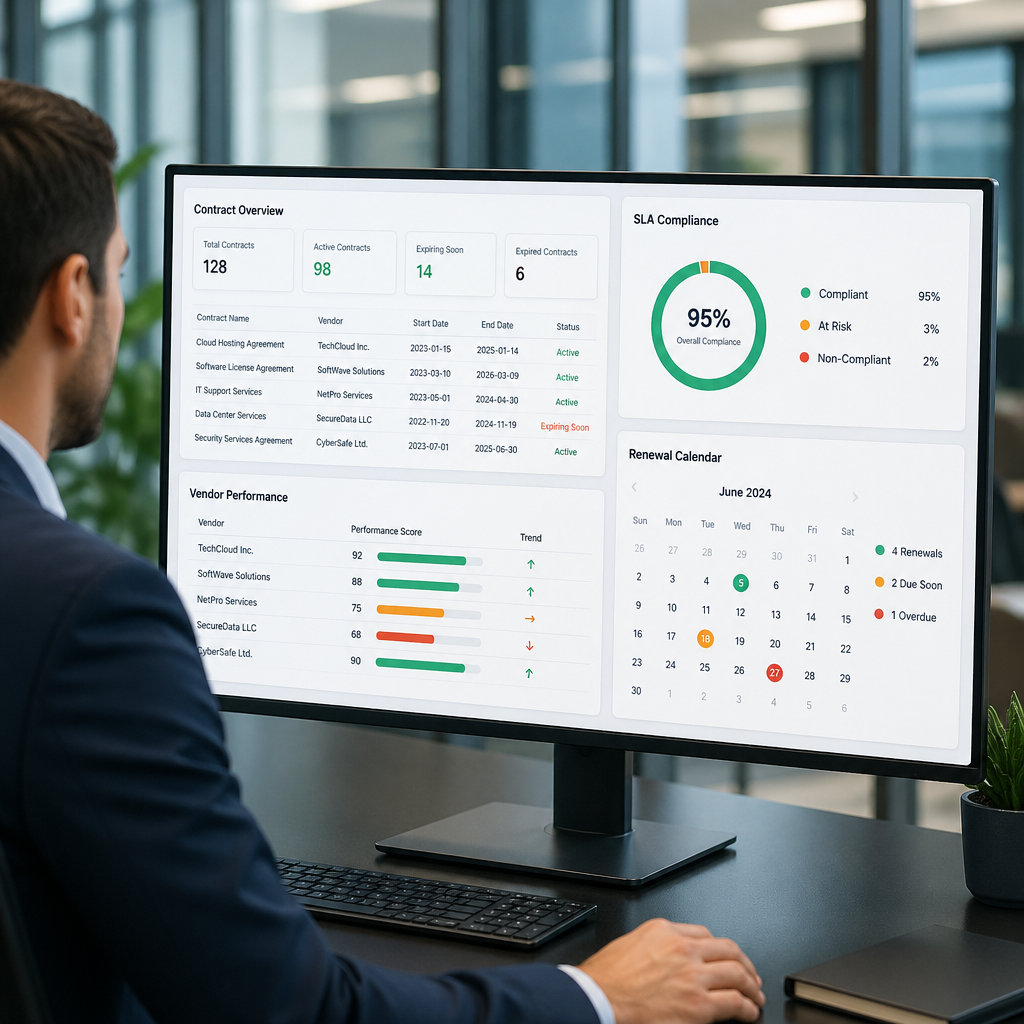
Service Level Agreements are only valuable if someone is tracking whether vendors are actually meeting them. Most businesses sign contracts with strong SLA provisions but never enforce them — allowing vendors to miss targets repeatedly without consequence. Triton monitors vendor SLA performance continuously and holds vendors accountable to the commitments they have made.
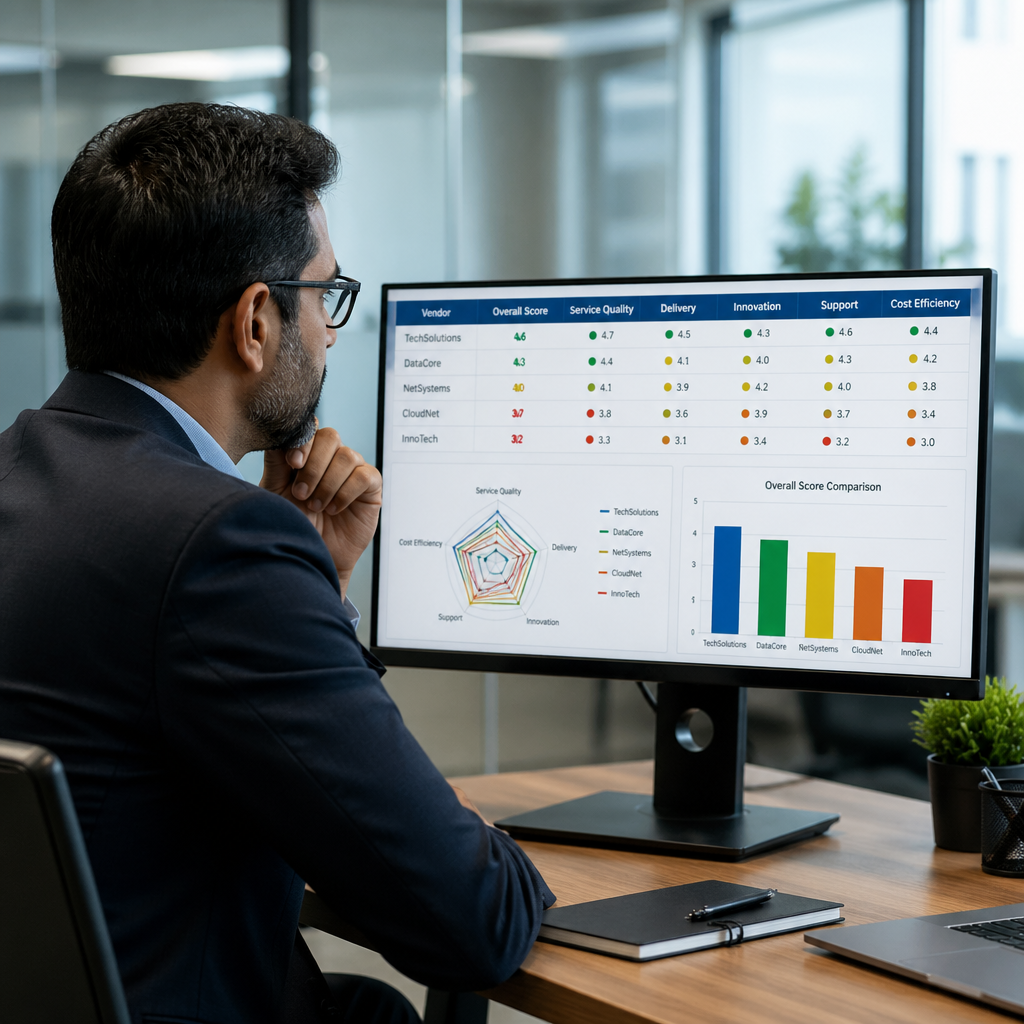
Performance metrics for each vendor are tracked and reviewed quarterly — uptime, response times, incident resolution rates, and any SLA credits earned but not yet applied. Triton prepares vendor scorecards that give your leadership team a clear, objective view of how each vendor is performing relative to their contractual commitments.
Vendor accountability reviews — formal conversations with vendor account teams about performance gaps, roadmap commitments, and service improvements — are conducted by Triton on your behalf. When vendors underperform, Triton escalates through the vendor’s account hierarchy and pursues contractual remedies including SLA credits and contract amendments.
Vendor Risk Assessment & Security
Third-party vendor risk is one of the most significant and underaddressed sources of security and compliance exposure for small and mid-sized businesses. Vendors with access to your systems, data, or networks can introduce security vulnerabilities that your own controls do not protect against. Triton conducts risk assessments for all technology vendors with access to your environment or data.
SOC 2 Type II attestations and ISO 27001 certifications from vendors demonstrate that their security controls have been independently verified — but only if someone is actually reviewing and tracking those certifications. Triton collects, reviews, and tracks vendor security certifications on your behalf, flagging expiring certifications and following up with vendors to obtain current documentation.
Vendor security questionnaires — standardized assessments of a vendor’s security practices — are a requirement of HIPAA Business Associate Agreements, PCI DSS third-party management, and CMMC supply chain risk management. Triton prepares and distributes vendor security questionnaires, reviews responses, escalates concerning answers, and maintains a vendor risk register that documents your third-party risk management program.

Procurement & Cost Optimization
Volume licensing agreements, enterprise discount programs, and multi-year prepay options can significantly reduce your technology spend — but only if someone is actively negotiating and managing those agreements. Triton leverages its knowledge of vendor pricing structures and discount programs to negotiate favorable terms on your behalf.
Competitive bidding disciplines vendor pricing and prevents the complacency that develops when vendors know they have no competition. Triton conducts periodic competitive reviews for major technology categories — ensuring your incumbent vendors are priced competitively and that better alternatives have not emerged in the market.
Eliminating duplicate tools is one of the fastest ways to reduce technology spend. Triton’s vendor audit frequently uncovers multiple tools performing the same function — acquired by different departments without coordination. Triton identifies consolidation opportunities and manages the transition to a single, best-in-class tool, eliminating the cost of redundant licenses.
Stop Overpaying for Technology You Don't Need
Triton Technologies takes ownership of your vendor relationships — contracts, renewals, SLAs, risk, and cost — so your team is not buried in vendor management tasks and your organization is not exposed to the risks that come from unmanaged vendor sprawl.
Vendor Management — Frequently Asked Questions
What does vendor management cover?
Triton vendor management covers the full lifecycle of your technology vendor relationships: initial vendor audit and inventory, contract repository management, renewal tracking, SLA monitoring and enforcement, performance reviews, vendor risk assessments, security questionnaire management, and procurement and cost optimization.
How does Triton select and recommend vendors?
Triton is vendor-neutral — we have no financial incentive to recommend one vendor over another. When evaluating vendors, we assess technical fit, security posture, compliance certifications, pricing and contract terms, financial stability, and references from similar organizations. Our recommendations are based exclusively on what is best for your business.
Can Triton help with contract negotiation?
Yes. Triton reviews technology contracts and negotiates on your behalf — addressing auto-renewal clauses, price escalation provisions, data portability rights, SLA remedies, and termination provisions. We have reviewed hundreds of technology contracts and know where vendors routinely include unfavorable terms that can be negotiated.
How much can vendor management save?
Most Triton clients see meaningful cost reductions through a combination of license right-sizing, elimination of duplicate tools, negotiated pricing improvements, and prevention of auto-renewals at list price. Savings vary by organization size and vendor complexity, but it is common to recover the cost of the managed service from vendor cost reductions alone.
How does vendor management help with security risk?
Triton tracks every vendor with access to your environment or data, conducts security risk assessments, collects and reviews security certifications (SOC 2, ISO 27001), and maintains a vendor risk register. When a vendor has a security incident, Triton evaluates the impact on your organization and manages the response — including BAA notifications for HIPAA-covered vendors.
How does Triton handle contract renewals?
Triton provides advance renewal notifications 90 to 180 days before each contract renewal, with a recommendation on whether to renew, renegotiate, or replace the vendor. We manage the renewal negotiation, review updated terms for material changes, and execute renewals on your behalf — ensuring no contract auto-renews without your explicit approval.
How do we get started?
Triton begins every vendor management engagement with a vendor audit — a comprehensive inventory of your technology vendors, contracts, and spend. This audit typically takes one to two weeks and produces a complete vendor registry, a contract summary, and an initial set of optimization and risk management recommendations. Contact Triton to schedule your vendor audit.
Vendor Risk & Compliance Requirements
Triton manages third-party vendor relationships to meet the documented risk management and supply chain security requirements of the compliance frameworks your business must meet.
HIPAA BAA Management
Business Associate Agreement management and vendor risk assessments for HIPAA-covered entities and their supply chains.
PCI DSS Third-Party
PCI DSS Requirement 12.8 — third-party service provider management, risk assessments, and compliance documentation.
CMMC Supply Chain
CMMC supply chain risk management requirements — vendor assessments and CUI access controls for DoD contractors.
NIST CSF
NIST CSF Identify function — asset management and supply chain risk management implementation.
SOC 2
Vendor management controls supporting SOC 2 availability and confidentiality trust service criteria.
ISO 27001
Supplier relationship management controls under ISO/IEC 27001:2022 Annex A controls 5.19 to 5.23.
NYDFS Third-Party
NYDFS 23 NYCRR 500 Section 11 — third-party service provider security policy and annual risk assessment requirements.
GLBA Vendor Oversight
Third-party oversight requirements under the updated GLBA Safeguards Rule for financial institutions.
How Triton Delivers
The Sophos XDR Mandate
We deploy Sophos Firewalls as the non-negotiable perimeter standard. Any firm operating without synchronized endpoint protection is an insurance liability. Sophos Endpoint (EDR/XDR) is the mandatory internal security layer.
AWS Scalability
We deploy on AWS because downtime is not an option. When a critical system goes down, AWS support responds with enterprise urgency, not a ticket queue. Every dollar of downtime is a dollar your IT provider owes you an answer for.
The AI Autonomous Advantage
Axiom, Triton’s proprietary AI monitoring system, gives our engineers real-time visibility that off-the-shelf tools cannot replicate. It is not for sale, it is how we deliver.
Founded in 2001
25 Years of IT Expertise
Serving New England
5 Regional Offices + Dublin & BVI
Under 10 Minute Response
84th Percentile · MSPbots Verified
Sophos Silver · Microsoft Solutions Partner
Security & Cloud Partners
HIPAA · CMMC · SOC 2 · PCI
Multi-Framework Compliance
Let's Discuss Your IT Needs
Triton Technologies delivers managed IT services, cybersecurity, and IT support for businesses across New England. Contact our team today to start a conversation about your technology environment.