Vulnerability Management
Managed Vulnerability Management
Triton Technologies provides continuous vulnerability management for businesses across the Northeast — scanning your environment for weaknesses, prioritizing by risk, managing patches, and coordinating penetration testing to keep your attack surface as small as possible.
You Cannot Fix What You Cannot See
Every unpatched vulnerability in your environment is an open invitation to attackers. The average business has hundreds of known vulnerabilities at any given time — but most lack the processes to systematically find, prioritize, and remediate them before they are exploited.
Triton’s managed vulnerability management program continuously scans your environment, prioritizes findings by exploitability and business impact, coordinates remediation, and tracks your vulnerability posture over time — giving you clear visibility into your risk and measurable improvement.
Triton Technologies provides managed vulnerability management to businesses across the Northeast — protecting organizations of every size under one managed agreement.
The Result Speaks for Itself
70+
Employees
Under Protection
0
Attacks
Ransomware-Free Decade
2
Months
To Full Remediation
Property Management Company — Greater Boston
A Boston-area property management company with dozens of locations was under constant ransomware attack. Their existing provider — a major national brand — was repeatedly patching rather than permanently resolving. When Triton assessed the environment, the finding was stark: absolutely no firewall, workstations running admin-level permissions by default, no file structure, no access authority hierarchy.
Within two months, Triton took over the full account. We implemented enterprise firewall and client-side filtering from zero, locked down the network and workstations, removed default admin permissions, imposed security policy, file structure, and access authorities, and deployed backup and monitoring. For nearly a decade since 2016, this client of 70+ employees has recorded zero ransomware attacks and zero email compromises. They remain a Triton client today, running cloud services that are secure, cost-effective, and support work from anywhere.
What Changed
Firewall from zero
Enterprise firewall and client-side filtering built where there had been no firewall at all.
Admin rights removed
Default admin permissions removed and every workstation locked down.
Order imposed
Security policy, file structure and access authorities put in place.
Backup and monitoring
Backup and monitoring deployed across the environment.
Zero incidents since 2016
No ransomware attacks and no email compromises in nearly a decade.
Still a client
Secure, cost-effective cloud services that support work from anywhere.
Nearly a decade. Zero ransomware attacks. Zero email compromises.
Continuous Vulnerability Scanning
Vulnerabilities are discovered daily. New CVEs are published, existing software is found to contain previously unknown flaws, and misconfigurations expose systems to attack. Point-in-time scanning is not enough — effective vulnerability management requires continuous scanning.
Triton deploys authenticated vulnerability scanners across your environment — scanning endpoints, servers, network devices, cloud workloads, and web applications on a continuous cycle. Every new vulnerability is identified within days of discovery, not months.
Scan results are correlated with asset inventory, business criticality, and active exploit intelligence — giving you a risk-prioritized view of your environment rather than an overwhelming list of CVEs.

Risk Prioritization & Remediation Planning
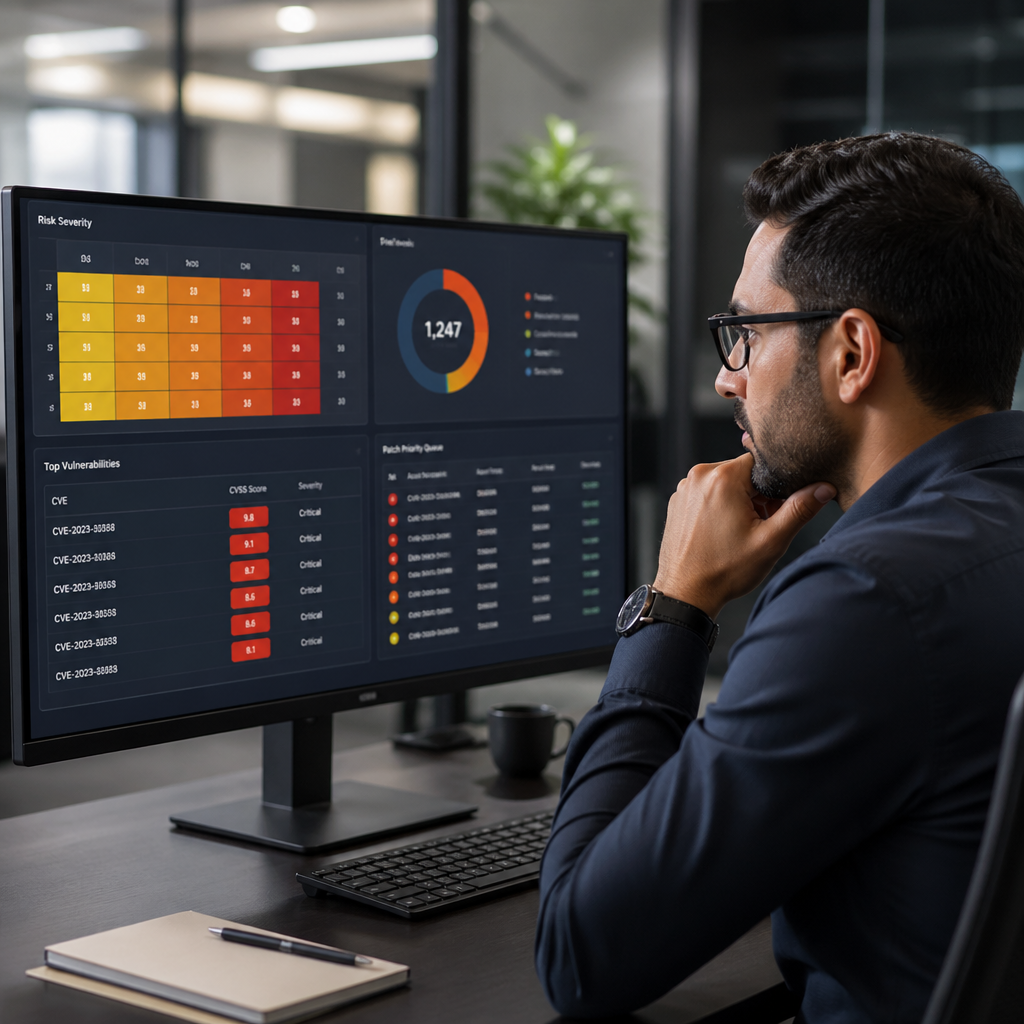
Not all vulnerabilities are equal. A critical vulnerability on an internet-facing server with an active exploit in the wild demands immediate action. The same vulnerability on an isolated internal test system can be scheduled for next month’s maintenance window.
Triton prioritizes your vulnerability backlog with four inputs, so your team focuses on the vulnerabilities that matter most, in the order that reduces risk fastest:
- CVSS scores
- EPSS (Exploit Prediction Scoring System) data
- asset criticality
- active exploitation intelligence
We produce weekly prioritized remediation plans that tell your team exactly what to fix, in what order, and why — eliminating the analysis paralysis that leaves critical vulnerabilities open for months.
Managed Patch Management
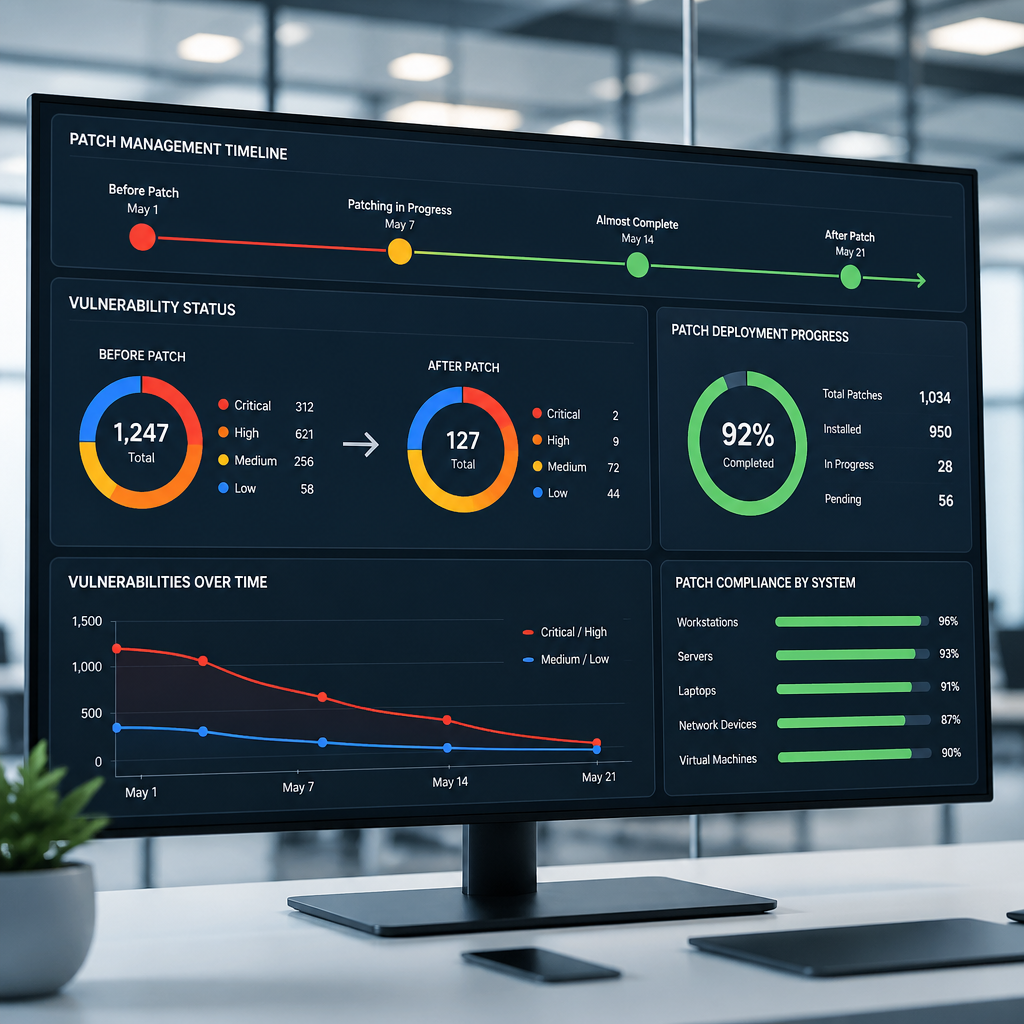
Vulnerabilities require patches. Patches require testing, deployment, and validation. For most businesses, this process is ad hoc, inconsistent, and months behind — leaving known vulnerabilities open long after patches are available.
Triton manages the full patch lifecycle: monitoring vendor security advisories, testing patches in staging environments, deploying to production on a documented schedule, and validating that patches are applied correctly. Critical security patches are deployed within 72 hours of release.
We maintain complete patch compliance reporting that satisfies the documentation requirements of PCI DSS, HIPAA, CMMC, and other frameworks — proving to auditors that your environment is maintained current.

Penetration Testing Coordination
Vulnerability scanning finds known weaknesses. Penetration testing simulates real attacks — discovering how vulnerabilities can be chained together, how far an attacker can move once inside, and what business impact a real attack would cause. Many compliance frameworks require annual penetration testing.
Triton coordinates penetration testing engagements with qualified, certified penetration testers — defining scope, managing the engagement timeline, reviewing results, and translating findings into actionable remediation plans.
Post-penetration test remediation is integrated back into your vulnerability management program — ensuring findings are tracked, prioritized, and resolved on a documented schedule.
Attackers Scan Your Systems Every Day — Are You Scanning Them First?
Threat actors continuously scan the internet for vulnerable systems. Triton’s vulnerability management program ensures you find your weaknesses before they do — and fix them before they can be exploited.
Managed Vulnerability Management — FAQ
What is vulnerability management?
Vulnerability management is the ongoing process of identifying, prioritizing, and remediating security vulnerabilities in your IT environment — covering software flaws, misconfigurations, missing patches, and weak security settings across all systems.
How often does Triton scan for vulnerabilities?
Triton conducts continuous vulnerability scanning on a defined schedule — typically weekly full scans with continuous monitoring for critical assets. New assets are scanned within 24 hours of discovery. Emergency scans are conducted when critical zero-day vulnerabilities are published.
What is the difference between vulnerability scanning and penetration testing?
Vulnerability scanning uses automated tools to identify known weaknesses — missing patches, misconfigurations, and known CVEs. Penetration testing uses human expertise to simulate real attacks, discovering how vulnerabilities can be exploited in combination to achieve specific business impacts.
Is penetration testing required for compliance?
Penetration testing is explicitly required by PCI DSS (annually and after significant changes), NYDFS 23 NYCRR 500 (annually), and CMMC. HIPAA does not currently mandate it, though a pending HHS proposal would require it annually. SOC 2 auditors typically expect annual penetration testing evidence.
How does Triton prioritize which vulnerabilities to fix first?
Triton prioritizes using a combination of CVSS base score, EPSS exploit prediction score (how likely a vulnerability is to be exploited in the next 30 days), asset criticality, and whether active exploits are in the wild. High-EPSS vulnerabilities on critical systems are always first.
What is a zero-day vulnerability?
A zero-day vulnerability is a software flaw that is actively being exploited before the vendor has released a patch. Triton monitors for zero-day disclosures and implements compensating controls — network isolation, enhanced monitoring, or temporary blocking of affected services — until patches are available.
How does patch management fit into vulnerability management?
Patch management is the remediation step for software vulnerabilities. Triton’s vulnerability management program identifies vulnerabilities, and the patch management process deploys the fixes. Both are required — scanning without patching leaves vulnerabilities open indefinitely.
Compliance Frameworks Requiring Vulnerability Management
Triton implements vulnerability management programs aligned with the requirements of the frameworks and regulations your business must comply with.
PCI DSS Req. 6 & 11
Vulnerability management and penetration testing requirements for cardholder data environments.
HIPAA Risk Analysis
Vulnerability identification as part of required security risk assessments.
CMMC
Risk assessment and vulnerability scanning controls required at all CMMC levels.
NIST CSF
Identify function — asset vulnerability management and risk assessment.
CIS Controls 7
CIS Control 7 — continuous vulnerability management implementation.
NYDFS 23 NYCRR 500
Annual penetration testing and risk-based automated vulnerability scanning requirements.
SOC 2
Vulnerability management evidence for security and availability trust service criteria.
GLBA Safeguards
Vulnerability assessments required as part of GLBA written information security programs.
How Triton Delivers
The Sophos XDR Mandate
We deploy Sophos Firewalls as the non-negotiable perimeter standard. Any firm operating without synchronized endpoint protection is an insurance liability. Sophos Endpoint (EDR/XDR) is the mandatory internal security layer.
AWS Scalability
We deploy on AWS because downtime is not an option. When a critical system goes down, AWS support responds with enterprise urgency, not a ticket queue. Every dollar of downtime is a dollar your IT provider owes you an answer for.
The AI Autonomous Advantage
Axiom, Triton’s proprietary AI monitoring system, gives our engineers real-time visibility that off-the-shelf tools cannot replicate. It is not for sale, it is how we deliver.
Founded in 2001
25 Years of IT Expertise
Serving New England
5 Regional Offices + Dublin & BVI
Under 10 Minute Response
84th Percentile · MSPbots Verified
Sophos Silver · Microsoft Solutions Partner
Security & Cloud Partners
HIPAA · CMMC · SOC 2 · PCI
Multi-Framework Compliance
Let's Discuss Your IT Needs
Triton Technologies delivers managed IT services, cybersecurity, and IT support for businesses across New England. Contact our team today to start a conversation about your technology environment.