
Overnight from 11 to 12 October 2026, attackers took remote control of the refrigeration systems in hundreds of French supermarkets and forced refrigerated and frozen cases into a continuous defrost. Some units were reported as high as 50 °C (122 °F). Stores threw away fresh and frozen food, and the Paris prosecutor’s office reported fires. This was not an attack on fridges in people’s homes. It hit the commercial controllers that run a whole store’s cooling, and it is a clear lesson for any business that runs equipment with its own web page.
Read the video transcript
What happened in French supermarkets?
Overnight from the eleventh to the twelfth of October, twenty twenty-six, attackers took remote control of the refrigeration systems in French supermarkets. They forced refrigerated and frozen cases into defrost, and some were reported as high as fifty degrees Celsius. Stores threw away fresh and frozen food, and the Paris prosecutor's office reported fires.
This was not an attack on fridges in people's homes. It targeted the commercial controllers that run a whole store's cooling. France's national cyber alert team, CERT-FR, issued an alert the same day.
What did the attackers change?
Every commercial freezer runs a defrost cycle. It is a short, normal heating phase that melts ice off the cooling coils. The attackers abused that feature.
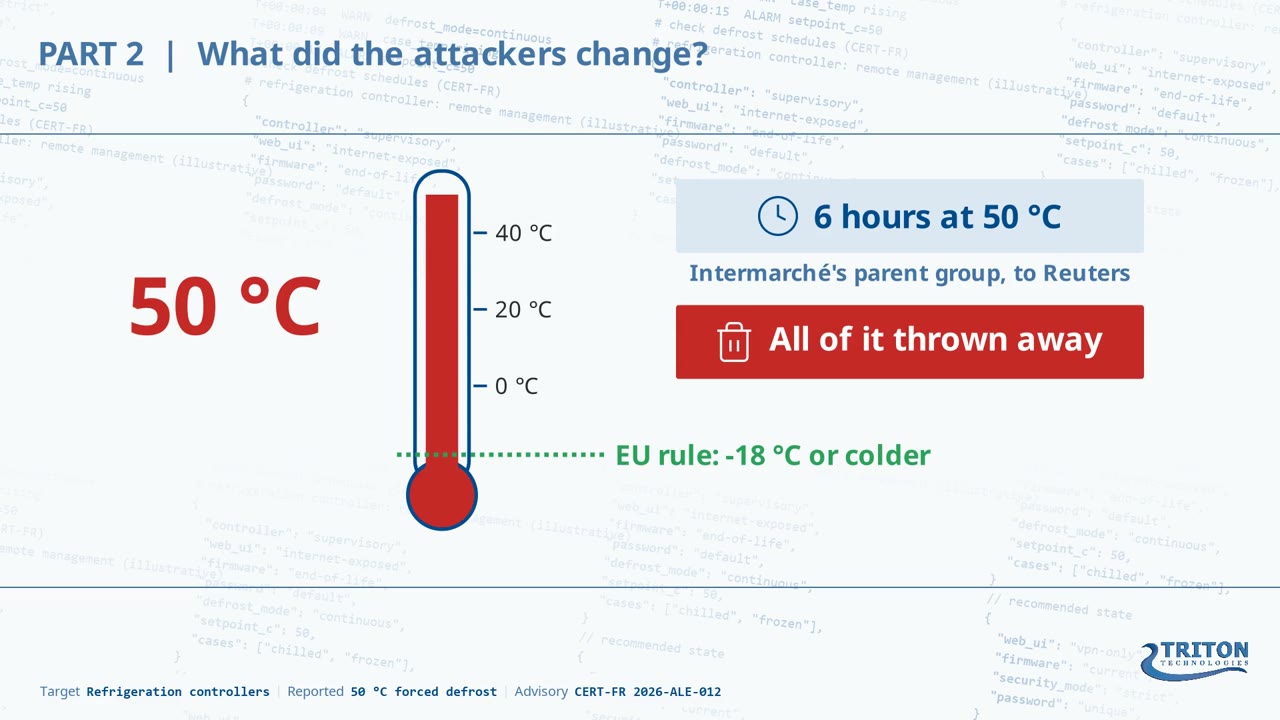
According to BFM-TV, as reported by the Associated Press, they forced a continuous defrost with temperatures set as high as fifty degrees Celsius. The group that owns Intermarché told Reuters its cases were heated to fifty degrees for six hours. European rules require quick-frozen food to stay at minus eighteen degrees or colder.
After hours of heat, that food could not be sold, and the group said it threw all of it away to avoid any health risk.
How did the attackers get in?
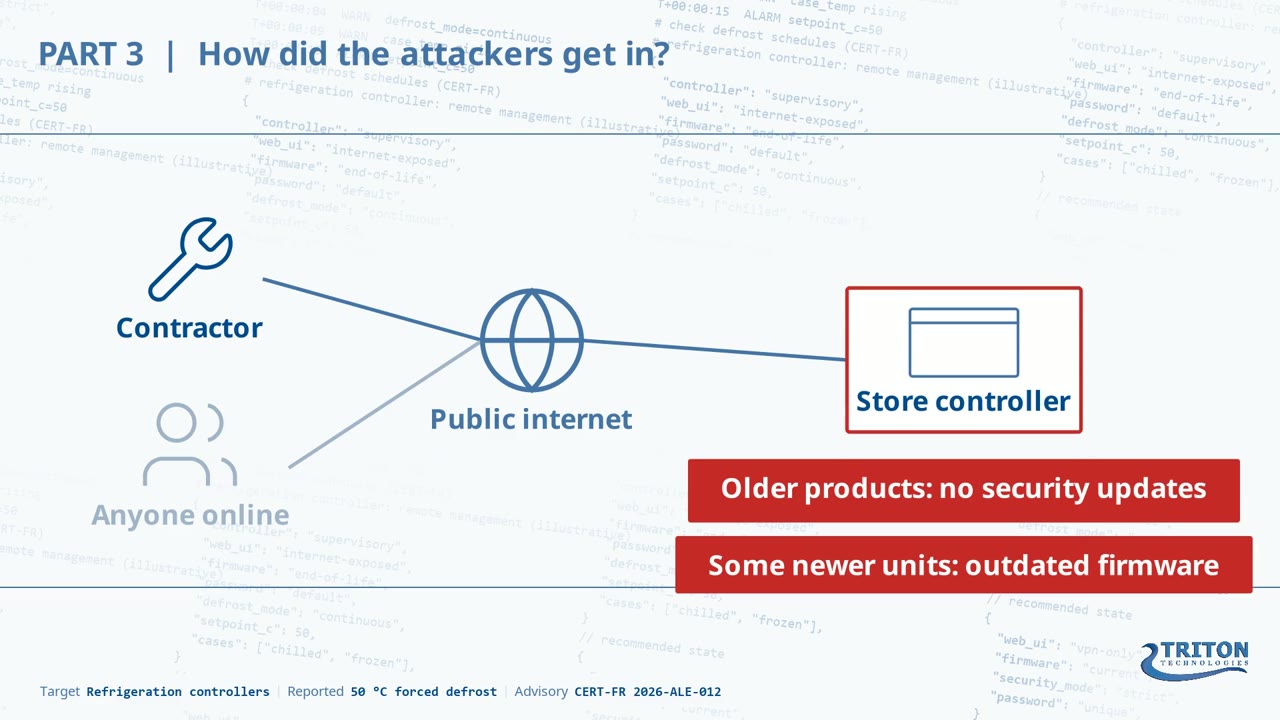
The exact entry point has not been made public. Here is what is known. The affected controllers, from Danfoss, and later Copeland and Dixell, have a web management page so refrigeration contractors can work on them remotely.
Many of those pages were reachable from the public internet. Danfoss said most of the systems hit were older products that no longer received security updates, and some newer units were running outdated firmware. Security flaws in a newer Danfoss model were disclosed and patched in twenty twenty-five, but no authority has said they were used here.
As of October eighteenth, no group has claimed the attack, and there has been no ransom demand.
How many stores were hit?
The count depends on who is counting. France's Finance Minister told Parliament that about seven hundred of the country's ten thousand supermarkets were affected. Coopérative U said eighty of its stores, and Carrefour said eighty.
The group that owns Intermarché gave about one hundred fifty stores to Reuters and three hundred to the Associated Press. On October eleventh, the scanning firm Censys counted one thousand eight hundred twenty-five Danfoss control panels exposed on the internet in France. By October fourteenth, that number had dropped to five hundred thirty-seven, as operators took them offline.
What did France's cyber agency tell businesses to do?
CERT-FR's advice is direct. Take these controllers off the public internet. Reach them only through a secure VPN or a protected network.
Update the firmware, turn on the vendor's strict security mode, and change every default password. Review the whole configuration, including the defrost schedules. And if a unit is end-of-life, a factory reset is not enough.
Left exposed, it will most likely be compromised again. The agency also warned that the attacks are probably still going on.
Could this happen to your business?
Any business with equipment that has its own web page carries the same risk. That includes building controls, HVAC, cameras, door access, and refrigeration. The defense is the same every time.
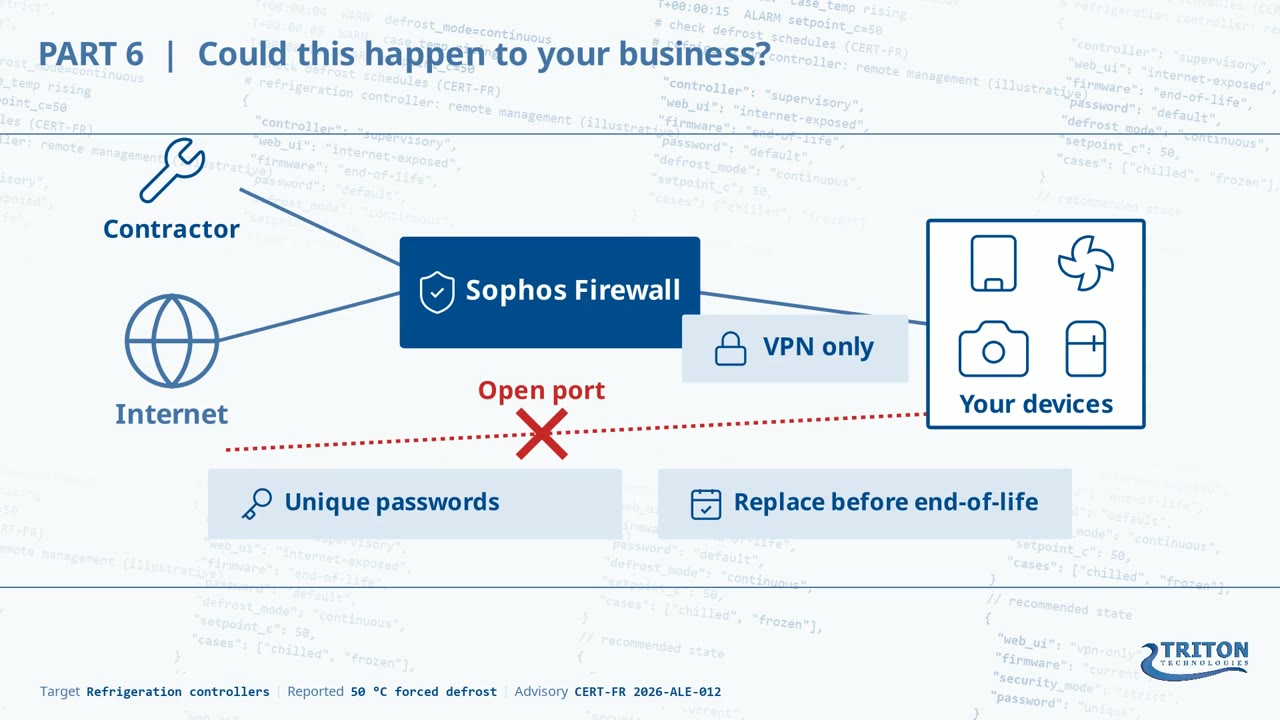
Know every connected device on your network. Keep management pages off the public internet, behind a firewall, with VPN-only access. Change default passwords, and replace equipment before it reaches end-of-life.
When a contractor needs remote access, it goes through that same controlled path, never an open port. At Triton, Sophos firewalls are the non-negotiable perimeter standard. A secure infrastructure is not set once and forgotten.
Triton proves it with penetration testing and intrusion testing, so the open doors are found and closed before an attacker finds them.
What happened in French supermarkets?
Reuters reported that hackers pushed many French supermarket fridges “to as high as 50°C” overnight, causing fires and food losses at several hundred stores (Reuters via TimesLive). The Paris prosecutor described a large-scale attack affecting connected refrigerators in several major food retailers across France, and the case was assigned to France’s anti-cybercrime office.
France’s national cyber alert team, CERT-FR, published alert CERTFR-2026-ALE-012 on 12 October 2026. It names the Danfoss AK-SC and AK-SM series, and on 13 October it added Copeland XWEB and Dixell XWEB (CERT-FR alert).
What did the attackers change?
Every commercial freezer runs a defrost cycle: a short, normal heating phase that melts ice off the cooling coils. The attackers abused that feature. According to BFM-TV, as reported by the Associated Press, they forced a continuous defrost cycle and set temperatures as high as 50 °C (AP via News4Jax).
Les Mousquetaires, the group that owns Intermarché, told Reuters its fridges were heated to 50 °C for six hours and that it threw all of the food away to avoid any health risk. For scale: EU rules require quick-frozen food to be kept at -18 °C or colder (Council Directive 89/108/EEC). After hours at 50 °C, none of it could be sold.
How did the attackers get in?
The exact entry point has not been made public. What is known:
- The affected controllers have a web management interface so refrigeration contractors can work on them remotely, and many of those interfaces were reachable from the public internet. CERT-FR states that exposing a management interface to the internet is contrary to good practice.
- Danfoss said most of the systems hit were older products that no longer received software or security updates (AP), and that some affected units were running outdated firmware (Reuters).
- Security flaws in a newer Danfoss model, the AK-SM 800A, were publicly disclosed and patched in 2025 (CISA ICSA-25-140-03). No authority has said they were used in this attack (The Register).
As of 18 October 2026, no group has claimed the attack and there has been no ransom demand (Reuters via Business Insurance).
How many stores were hit?
The count depends on who is counting. France’s Finance Minister told Parliament that about 700 of the country’s 10,000 supermarkets were affected. Coopérative U said 80 of its roughly 2,000 stores, and Carrefour said 80. Les Mousquetaires gave about 150 stores to Reuters and 300 to the Associated Press.
The scanning firm Censys counted 1,825 internet-exposed Danfoss StoreView control panels in France on 11 October. By 14 October that number had dropped to 537, which Censys read as operators taking the panels offline rather than patching them (Infosecurity Magazine).
What did France’s cyber agency tell businesses to do?
CERT-FR’s recommendations for these controllers are direct:
- Take them off the public internet.
- Reach them only through a secure VPN or a protected network.
- Update the firmware, turn on the vendor’s strict security mode, and change every default password.
- Review the whole configuration, including the defrost schedules.
For end-of-life units, CERT-FR warns that a factory reset is not enough: a device left exposed will most likely be compromised again. The agency also warned that the attack campaigns are probably still ongoing (CERT-FR alert).
Could this happen to your business?
Any business with equipment that has its own web page carries the same risk: building controls, HVAC, cameras, door access and refrigeration. The defense does not change with the device. Know every connected device on your network. Keep management pages off the public internet, behind a firewall, with VPN-only access. Change default passwords, and replace equipment before it reaches end-of-life. When a contractor needs remote access, it goes through that same controlled path, never an open port.
At Triton, Sophos firewalls are the non-negotiable perimeter standard. A secure infrastructure is not set once and forgotten. Triton proves it with penetration testing and intrusion testing, so the open doors are found and closed before an attacker finds them.
Sources
- CERT-FR, alert CERTFR-2026-ALE-012, 12 to 16 October 2026
- Reuters via TimesLive, Hackers heat French supermarket fridges, sparking fires and food losses, 12 October 2026
- Associated Press via News4Jax, Cyberattack targeting refrigeration systems hits 700 supermarkets, 13 October 2026
- Reuters via Business Insurance, Investigators hunt French supermarket fridge hackers, 13 October 2026
- Infosecurity Magazine, exposed Danfoss controllers in France, October 2026
- The Register, 13 October 2026
- CISA ICS Advisory ICSA-25-140-03, Danfoss AK-SM 8xxA Series, 20 May 2025, updated 26 August 2025
- Council Directive 89/108/EEC on quick-frozen foodstuffs
Let's Discuss Your IT Needs
Triton Technologies delivers managed IT services, cybersecurity, and IT support for businesses across New England. Contact our team today to start a conversation about your technology environment.

Related articles
- What Do the New Britain and Meriden Ransomware Attacks Mean for Connecticut Businesses? · Sep 29, 2026
- What Happened in the MetroWest Community Federal Credit Union Ransomware Breach in Framingham? · Sep 29, 2026
- What Happened in the Form Energy Ransomware Attack in Somerville, and What Should Employers Learn? · Sep 29, 2026